
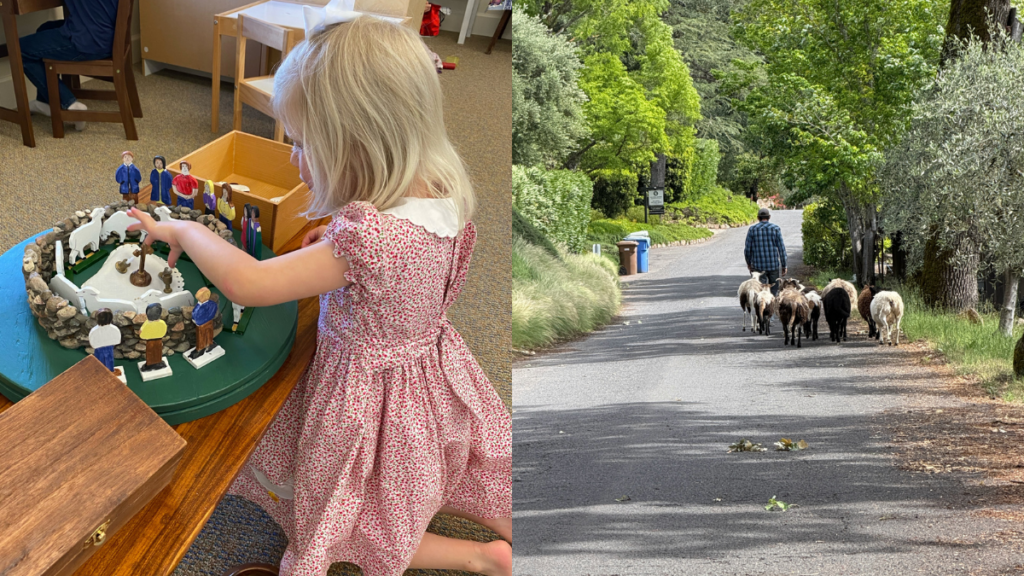
Last Sunday, as we do every Fourth Sunday of the Easter season, we celebrated Good Shepherd Sunday.
Good Shepherd Sunday used to be one of my least favorite Sundays of the church year. In part, I had reacted badly to an overly romanticized, saccharine Victorian image of the Good Shepherd in flowing robes, carrying a fluffy white sheep—an image that did not seem to have much to do with the gritty reality of life. The second reason was simpler: most of us do not respond favorably to being compared with sheep!
However, that all changed when I came to Grace and discovered Catechesis of the Good Shepherd, our children’s formation program.
Through many years of prayerful observation and trial and error, the originator of the program, Sophia Cavalletti, along with her Montessori-trained collaborator, Gianna Gobbi, discovered that children from the youngest ages onward deeply respond to—and need—the loving relationship with Jesus as their Good Shepherd.
The Good Shepherd became the foundation and namesake of the program. It is shared with the children through hands-on materials beginning at age three, with different layers of the parable from John chapter 10 and Psalm 23 added as they grow.
One of my favorite reflections is found in a presentation called The Eucharistic Presence of the Good Shepherd. Once the children have realized on their own—this is not told to them—that we are the fortunate sheep, so loved and cared for by the Good Shepherd, we help them make the connection to the sheepfold of the Church. The sheep are taken from the sheepfold and placed around an altar where we know that Jesus gives his whole self to us in the bread and the wine. The sheep are then replaced with people, with one sheep, the priest, being given the task of repeating Jesus’ words: “This is my body, this is my blood.”
Two weeks ago, one of our children—a three-year-old, relatively new to the Atrium (the space set aside for Catechesis of the Good Shepherd)—re-enacted this in her holy play. She set the altar in the sheepfold itself, giving each sheep a taste of the bread and a sip of the wine, while allowing the human figures to gather around the outside of the sheepfold. She hummed and chanted softly to herself as she worked.
It was such a gorgeous synthesis of what the very youngest know: that our Good Shepherd carries us no matter what, that he is always there wanting to nurture us and feed us and give himself to us. And we are so much better off when we can listen to his voice.
There was also an actual—and entirely unintentional—reenactment of the parable of the Good Shepherd that Grace member Paul Asmuth experienced and shared last week. A group of grazer sheep had escaped from the vineyard where they were supposed to be and wandered into the Napa Valley Reserve. Workers corralled the scared, confused sheep while calls were made to neighbors trying to discover where they belonged. It took about an hour for the shepherd to be located, but as soon as he arrived, the sheep immediately became calm and completely attentive to him. He called out to them in a sing-song voice, and the sheep just followed him right down the street, happy as could be.
The language in John chapter 10 includes thieves, bandits, and wolves sneaking in to kill and steal and destroy. It can be easy to overlook the loving words of Jesus in John 10:10: “I came that they may have life, and have it abundantly.” This abundant life is there for us whenever we choose to claim it—whenever we can take our eyes and attention off the thieves and wolves and bandits of the world and place them on Jesus.
As we have been gathering together in the Grace Gatherings this spring, we have been asked the question: Why do you come to church on Sunday morning? I think one main reason I come to church on Sunday morning is to be with my fellow sheep. We are so blessed not only to have this loving relationship with our Good Shepherd, but also to realize that we do not need to do it alone—that we are part of a flock, gathered together in the sheepfold.
As we go out and come in and find pasture, we have the opportunity to share that love and care, that deep peace, with others who need it so very much.
In the deep peace of the sheep, Amy+
Recent Comments